


Bottle and Jar Size Guide: How to Choose the Right Capacity
Choosing a bottle or jar is not only about appearance. The capacity of the container affects the cost per unit, preservation, ease of filling, type of closure, transport, presentation and even how the consumer uses the product.
A container that is too large may be more difficult to sell or may leave the product exposed to air for longer after opening. A container that is too small can increase filling, labelling and transport costs. The right choice should balance the product, its usual consumption quantity and the purpose of the packaging.
In this guide from Abadia Rural, we explain how to choose bottle and jar sizes for wine, craft beer, olive oil, vinegar, liqueurs, honey, jams, sauces, preserves, gifts, samples and other artisan products.
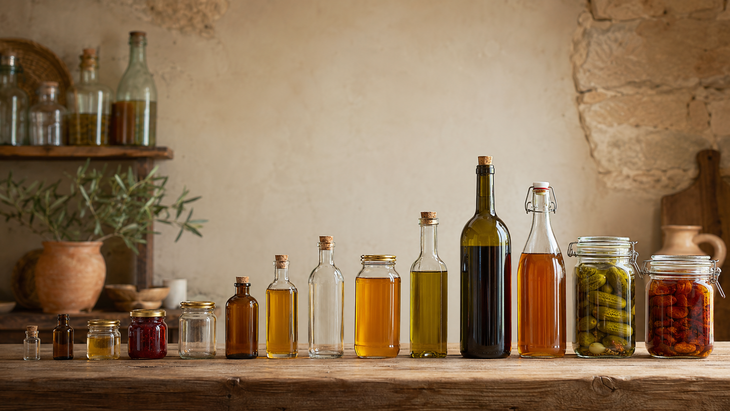
What is the difference between nominal and total capacity?
When comparing containers, it is important to distinguish between nominal capacity and total capacity.
Nominal capacity is the quantity of product for which the container was designed and marketed. Total capacity represents the approximate maximum volume up to the physical limit of the container.
In practice, a bottle or jar should not necessarily be filled to the very top. It is customary to leave some space between the product and the closure. This space, often called headspace, can be important for:
- applying the lid, cork or capsule correctly;
- allowing for normal product expansion;
- reducing spills during closure;
- carrying out certain pasteurisation processes;
- controlling pressure in fermented drinks;
- maintaining a consistent presentation across containers.
The amount of space required depends on the product, filling process and closure system. You should not choose a container based solely on its maximum capacity when filled to the rim.
Millilitres and grams are not the same
A common mistake is to assume that a 250 ml container will necessarily hold 250 g of any product.
Millilitres measure volume, while grams measure weight. The relationship between them depends on the density of the product.
- 250 ml of water weighs approximately 250 g.
- 250 ml of honey weighs considerably more than 250 g.
- 250 ml of dried herbs may weigh much less than 250 g.
- Jams, sauces and creams have different densities.
If you intend to sell the product by weight, carry out tests with the final recipe before ordering a large quantity of containers. Fill one unit, leave the necessary space for the closure and weigh the actual contents.
This check is particularly important for honey, jams, preserves, thick sauces, spices and dried products.
Bottles up to 50 ml: samples, gifts and special presentations
Miniature bottles are suitable for small quantities and products with a high value per volume.
Some of their most common uses include:
- samples of olive oil, vinegar or liqueur;
- wedding, christening or event favours;
- gift hampers and tasting sets;
- essences and extracts;
- promotional products;
- small gifts from local producers.
These containers make it possible to present several flavours in a single set and allow customers to try a product before purchasing a larger format.
However, the cost of the bottle, closure and label represents a larger proportion of the final price. You should also confirm that there is sufficient space for a legible label.
Browse the bottles up to 50 ml available from Abadia Rural, including formats such as the Jerezana Futura 50 ml glass bottle.
Bottles from 51 ml to 250 ml: small batches and gift formats
Capacities between 51 ml and 250 ml are versatile and suitable for products that are normally used in small quantities.
They can be used for:
- speciality olive oils and vinegars;
- hot sauces;
- syrups;
- artisan liqueurs;
- extracts and infusions;
- single-serving drinks;
- hampers and gifts;
- tasting products.
When should you choose 100 ml?
A 100 ml capacity works well for generous samples, favours and concentrated products. It also provides more room for a label than a miniature bottle.
One example is the Hertz 100 ml glass bottle.
When should you choose 200 ml or 250 ml?
The 200 ml and 250 ml formats offer a balance between an individual package and a quantity sufficient for several uses.
They are particularly useful for olive oil, vinegar, sauces, syrups, liqueurs, small juices and gastronomic gift sets.
Explore the bottles from 51 ml to 250 ml, where you will find different formats, glass colours and neck types.
Bottles from 251 ml to 500 ml: one of the most versatile ranges
Capacities between 251 ml and 500 ml are suitable for many artisan and commercial products. They provide a practical quantity without making the package too heavy or bulky.
This range is commonly used for:
- craft beer;
- olive oil and vinegar;
- liqueurs;
- sauces and syrups;
- juices;
- small wine productions;
- fermented drinks;
- special editions.
Capacities around 330 ml
Formats around 330 ml are frequently associated with beer, cider and other individual drinks. When gas or bottle refermentation is involved, choosing the right capacity is not enough: the container must also be suitable for pressure.
350 ml bottles
A 350 ml bottle can create a distinctive presentation for liqueurs, speciality drinks, olive oils or promotional products. Abadia Rural offers options such as the Motorrad 350 ml glass bottle.
500 ml bottles
A capacity of 500 ml is a familiar option for olive oil, vinegar, beer, certain wines, liqueurs and artisan drinks. It provides a good labelling area and a practical quantity for household use.
Browse all bottles from 251 ml to 500 ml.
Bottles from 501 ml to 1000 ml: wine, drinks and family formats
Bottles between 501 ml and 1000 ml are suitable for products intended for regular or shared consumption.
Some of their most common uses include:
- wine;
- cider;
- large-format beer;
- juices;
- olive oil;
- vinegar;
- liqueurs for household consumption;
- still or carbonated fermented drinks, using the appropriate bottle.
Why is 750 ml such a common capacity?
The 750 ml bottle is widely used for wine and offers a good balance between quantity, ease of serving, storage and transport.
Before choosing a wine bottle, you should also confirm the type of cork, glass colour, bottle shape and the filling and corking equipment available.
For a more complete overview of the process, read How to Make Wine at Home: A Complete Guide.
Explore the category of bottles from 501 ml to 1000 ml.
Jars up to 50 ml: samples and concentrated products
Jars up to 50 ml are suitable for products used in very small quantities.
They can be chosen for:
- samples of honey or jam;
- spices;
- cosmetic products;
- ointments and balms;
- concentrated ingredients;
- favours and tasting sets.
With these formats, the size of the opening is particularly important. A very small jar with a narrow opening can be difficult to fill when the product is thick or contains pieces.
Browse the jars up to 50 ml.
Jars from 51 ml to 250 ml: honey, jams, spices and sauces
This range includes several popular formats for small batches, gifts and direct sales.
It is suitable for:
- small quantities of honey;
- jams and jellies;
- chutneys;
- sauces;
- herbs and spices;
- pâtés and spreads;
- cosmetic products;
- hampers of regional products.
Jars from 120 ml to 167 ml
These formats work well for speciality products, tasting sets and recipes with a higher price per kilogram. They provide a useful quantity without increasing the final price excessively.
212 ml jars
The 212 ml capacity is widely used in artisan production because it provides enough space for jams, sauces, chutneys and small quantities of preserves.
One example is the straight-sided 212 ml glass jar.
Browse all jars from 51 ml to 250 ml.
Jars from 251 ml to 500 ml: the intermediate format for artisan products
Jars between 251 ml and 500 ml are among the most versatile options for household and commercial use.
They can be used for:
- jams and preserves;
- honey;
- sauces and chutneys;
- preserved vegetables;
- olives;
- pâtés;
- nuts and dried fruit;
- food products intended for regular use.
290 ml and 314 ml jars
These capacities provide a useful amount of product without making the package too heavy. They are suitable for local markets, specialist shops, hampers and small retailers.
The shape also affects how the product is perceived. A hexagonal jar may stand out on a shelf, while a straight-sided model can make labelling and storage easier.
The available options include the Quadro Firenze 314 ml glass jar.
Jars from 370 ml to 500 ml
These are practical choices for families, regular customers and products used over several meals. Before increasing the capacity, consider how long the product will remain open after its first use.
Explore the jars from 251 ml to 500 ml.
Jars from 501 ml to 1000 ml: preserves and family use
Larger formats are suitable for products consumed regularly, family recipes and larger preserves.
They are frequently used for:
- preserved vegetables;
- olives;
- family-sized sauces;
- preserved fruit;
- larger quantities of honey;
- pulses;
- dried products;
- home fermentation appropriate to the type of jar.
A larger jar reduces the number of containers required, but it is heavier and may remain open for longer. It should be chosen when the quantity matches the expected rate of consumption.
The width of the opening also deserves attention. Products containing pieces, whole vegetables or thick preparations are easier to fill and remove through a wide opening.
Browse the jars from 501 ml to 1000 ml.
Jars over 1000 ml: large quantities and household preservation
Jars with a capacity greater than one litre can be useful for storing dried foods, larger preserves and products used regularly at home.
Before choosing these formats, consider:
- the total weight after filling;
- the strength of the shelf;
- ease of transport;
- the time required to consume the product after opening;
- the preservation method used;
- compatibility between the jar and lid;
- ease of washing and sterilisation.
Browse the jars from 1001 ml upwards.
Practical table of capacities and uses
| Capacity | Common uses | Main advantage | What to confirm |
|---|---|---|---|
| Up to 50 ml | Samples, favours, essences and tastings | Small volume and distinctive presentation | Available labelling space |
| 51–100 ml | Liqueurs, syrups, speciality oils and cosmetics | Small but functional format | Closure compatibility |
| 101–250 ml | Sauces, honey, jams, olive oil and hampers | Good format for gifts and trial purchases | Actual weight of the contents |
| 251–500 ml | Beer, olive oil, liqueurs, honey, jams and preserves | Excellent versatility | Product type and internal pressure |
| 501–750 ml | Wine, cider, olive oil, drinks and preserves | Suitable quantity for sharing | Weight, transport and storage |
| 751–1000 ml | Honey, preserves, drinks and family products | Fewer containers for the quantity produced | Consumption time after opening |
| Over 1000 ml | Large preserves and dried foods | Storage of larger quantities | Weight, handling and shelf strength |
Capacity is not the only consideration
Two bottles with the same capacity can be suitable for completely different purposes. Before making a decision, you should also assess:
Container shape
Tall, narrow bottles create a different presentation from short, wide models. With jars, straight sides make labels easier to apply, while decorative shapes can help the product stand out.
Glass colour
Dark glass can offer additional protection from light for sensitive products such as olive oil, certain wines, beer and extracts.
Opening diameter
A narrow neck is suitable for liquids. A wide opening makes it easier to fill and use honey, jams, thick sauces, vegetables and preserves containing pieces.
Type of closure
The bottle or jar must be compatible with the chosen lid, cork, capsule or crown cap. The diameter and closure system should be confirmed before purchase.
Read Lids, Corks and Capsules: How to Choose the Right Closure and browse the caps and corks category.
Pressure resistance
Not every bottle can withstand carbonated drinks or bottle refermentation. For craft beer, sparkling cider, sparkling mead and other carbonated drinks, use only containers suitable for the expected pressure.
How to test a container before placing a larger order
Before adopting a new container for your entire production, carry out a small-scale test.
- Choose a few containers with different capacities.
- Fill them with the final product, not just water.
- Measure or weigh the actual quantity placed in each one.
- Confirm the space required at the top.
- Test the application of the lid or cork.
- Place a sample label on the container.
- Check its stability and ease of transport.
- Simulate normal use after opening.
- Confirm that the container fits the boxes and shelves you use.
- Calculate the complete cost per unit.
This simple test can prevent filling problems, oversized labels, incompatible closures, containers that are difficult to transport and quantities that are impractical for the customer.
Preparation, closure and storage
After choosing the capacity, the container must still be prepared and used correctly.
Before filling, read our guide on how to sterilise glass bottles and jars properly.
After choosing and applying the closure, follow the recommendations in How to Store Bottles and Jars After Filling.
These three elements—capacity, closure and storage—should be considered together to protect the product and reduce losses.
Frequently asked questions about bottle and jar sizes
What is the best jar size for jam?
It depends on the price, type of customer and how quickly the product will be consumed. Formats such as 212 ml, 290 ml, 314 ml and 370 ml are practical options for many artisan products. A smaller version may be suitable for hampers and tastings, while a larger format may be better for family use.
What capacity should I choose for honey?
The choice should be based on the weight of honey you intend to sell, not only the millilitres stated for the jar. Because honey is denser than water, you should fill and weigh a sample before defining the commercial format.
What size is most suitable for olive oil?
The 250 ml and 500 ml formats are practical for speciality olive oils, gifts and household use. A larger capacity may be appropriate for regular customers. You should also consider the glass colour, closure type and protection from light.
Can I use any 500 ml bottle for beer?
No. Capacity does not confirm that the bottle is pressure resistant. For carbonated or bottle-conditioned beer, use a bottle specifically designed for this type of drink and a compatible closure.
Is a 750 ml bottle only suitable for wine?
No. It can be used for different drinks, provided that its shape, strength and closure are appropriate. However, it is a particularly common capacity within the wine sector.
How do I know which lid to buy for a jar?
Confirm the type and diameter of the jar opening, such as TO58, TO63, TO66, TO77 or TO82. Capacity alone does not determine the correct lid.
Should I choose a small or large container?
A small container encourages trial purchases and can reduce the initial selling price. A larger container reduces the number of packages required but increases the weight and may remain open for longer. The best choice depends on the product and customer behaviour.
Find the right capacity at Abadia Rural
At Abadia Rural, you will find glass bottles and glass jars in different capacities, shapes, colours and neck types.
You will also find caps, corks and accessories to complete the filling and preservation process.
When requesting advice, tell us what you intend to package, the desired quantity per unit, the preservation method and the type of presentation you require. This information will help us identify options that are better suited to your production.
Need help choosing?
If you still have questions about the most suitable capacity, shape or closure, contact Abadia Rural. Tell us what you intend to package and the approximate quantity required per unit.


