

Lids, Corks and Capsules: How to Choose the Right Closure for Bottles and Jars
Choosing the right bottle or jar is only half the job. To preserve wine, craft beer, cider, mead, honey, jams, liqueurs, olive oils or preserves safely, it is just as important to choose the right closure.
The wrong lid, a poorly chosen cork or an unsuitable capsule can compromise the seal, allow air to enter, cause leaks, alter the flavour of the product or significantly reduce its shelf life.
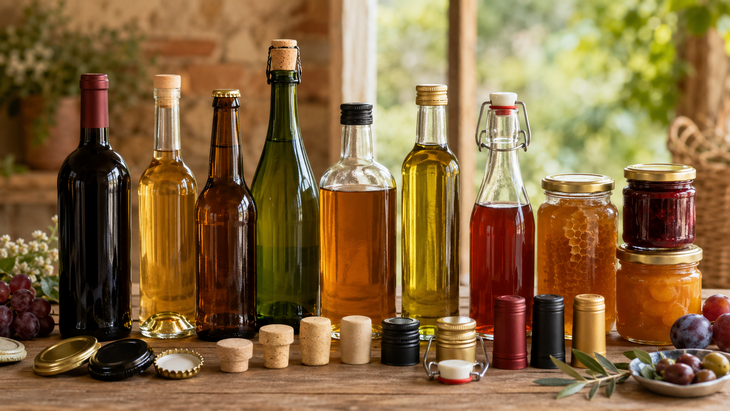
In this Abadia Rural guide, we explain how to choose between Twist-Off lids, natural corks, synthetic corks, capsules, crown caps, screw caps and swing-top closures, depending on the type of product you want to bottle or preserve.
Why is the closure so important?
The closure of a bottle or jar does much more than simply “cover” it. It plays an essential role in preservation, presentation and product safety.
- It prevents air from entering.
- It reduces the risk of contamination.
- It helps preserve aromas and flavours.
- It prevents leaks during transport.
- It allows for longer preservation.
- It contributes to a more professional presentation.
As we explained in our guide on how to choose the right glass bottle, each product has specific requirements. The same applies to closures.
A wine bottle does not require the same type of seal as a beer bottle. A honey jar should not be closed in the same way as a jam jar. And a liqueur bottle may have different requirements from an olive oil or vinegar bottle.
Before choosing: think about the product you want to preserve
The choice of lid, cork or capsule should always begin with the product itself.
Before buying, ask yourself:
- Is the product liquid, thick or solid?
- Will it continue to ferment after closing?
- Does it contain gas or internal pressure?
- Does it require ageing?
- Will it be pasteurised?
- Will it be transported or sold?
- Does it need a traditional, premium or functional presentation?
These answers will help you understand whether you should use a cork, a metal lid, a capsule, a crown cap, a swing-top closure or a screw cap.
Twist-Off lids: ideal for jars, jams, honey and preserves
Twist-Off lids are one of the most commonly used solutions for glass jars. They are practical, economical, easy to apply and highly effective when used correctly.
They are especially suitable for:
- Jams.
- Jellies.
- Honey.
- Homemade sauces.
- Vegetable preserves.
- Chutneys.
- Pâtés.
- Food products packed in jars.
At Abadia Rural, you can find several options for caps and corks, including solutions adapted to different jar diameters.
There are also specific categories such as glass jars with metal lids, honey jars and jam jars, making it easier to choose the right combination.
When should you use Twist-Off lids?
Twist-Off lids are an excellent choice when you need a good seal, easy opening and a clean presentation.
They are particularly useful for products that may be pasteurised or stored for longer periods, provided that both the jar and the lid are compatible with that process.
If you produce jams, sauces or preserves, we also recommend reading our article on how to prepare and preserve homemade sauces in glass jars and bottles.
Important care with Twist-Off lids
Although they are simple to use, Twist-Off lids require some care.
- They must match the exact diameter of the jar.
- They must be clean and free from rust.
- They must not show any deformation.
- The inner sealing compound must be in good condition.
- They should not be reused when a perfect seal is required.
A lid that is too small, too large or slightly deformed can prevent a proper vacuum from forming and compromise preservation.
Natural corks: the classic choice for wine and liqueurs
Natural corks remain the classic solution for bottling wine. They are natural, traditional and strongly associated with the quality image of Portuguese wine.
They are especially suitable for:
- Wine.
- Some liqueurs.
- Mead.
- Beverages that benefit from a traditional presentation.
If you are producing wine on a small scale, our guide on how to make wine at home can help you better understand the full process, from fermentation to storage.
In the shop, you can browse options related to conical cork stoppers and various cork stoppers.
Natural or synthetic corks?
The choice between natural and synthetic corks depends on the product, the intended storage time and the desired presentation.
| Type of cork | Recommended use |
|---|---|
| Natural cork | Wines, mead and products with a traditional presentation. |
| Synthetic cork | Beverages intended for faster consumption, liqueurs and productions where greater uniformity is desired. |
| Conical cork | Demijohns, special jars, artisan containers and some laboratory or decorative uses. |
Natural corks should not be boiled. Excessive heat can alter the structure of the cork, reduce its elasticity and compromise the seal.
Capsules: protection, presentation and a professional finish
Capsules are used to protect the cork or neck area and give the bottle a more professional finish.
They are very common in:
- Wine bottles.
- Liqueur bottles.
- Olive oil bottles.
- Decorative bottles.
- Products intended for sale or gifting.
At Abadia Rural, you can find categories such as TO capsules, as well as bottle accessories and complementary solutions.
When properly applied, capsules help protect the closure, improve presentation and convey a more refined image to the final consumer.
Crown caps: essential for craft beer
Crown caps are the traditional closure for beer bottles.
They are suitable for:
- Craft beer.
- Some ciders.
- Fermented beverages under pressure.
- Home productions in bottles suitable for beer.
If you produce craft beer, we also recommend reading our article How to Brew Beer at Home and the article The Art of Home Brewing.
In the shop, you will find useful categories such as beer bottles, crown caps and cappers and corkers.
Pay attention to pressure in fermented drinks
Beer, cider, kombucha and some fermented drinks can generate pressure inside the bottle. Therefore, it is not enough to choose a closure that seals well; you must also choose a bottle designed for that type of use.
For carbonated drinks or secondary fermentation, always use:
- Pressure-resistant bottles.
- Suitable closures.
- New crown caps or swing-top closures in good condition.
- Appropriate equipment for applying the closure.
If you want to produce cider, the article How to Make Homemade Cider is a good starting point.
Swing-top closures: practical, reusable and versatile
Bottles with mechanical closures, often known as swing-top bottles, are highly appreciated by artisan producers because they can be reused many times.
They are suitable for:
- Craft beer.
- Cider.
- Kombucha.
- Infused waters.
- Liqueurs.
- Homemade drinks intended for relatively quick consumption.
At Abadia Rural, you can browse the category of swing-top bottles, as well as associated sealing accessories.
The most important point with this type of closure is to regularly check the condition of the rubber gasket. An aged, hardened or deformed gasket can cause leaks and loss of pressure.
Screw caps: practical for olive oil, vinegar, liqueurs and daily use
Screw caps are a practical solution for many liquid products, especially when easy opening and repeated closing are required.
They are often used for:
- Olive oil.
- Vinegar.
- Liqueurs.
- Liquid sauces.
- Essences.
- Food or artisan products.
For this type of use, you can browse categories such as threaded metal and plastic caps, olive oil and vinegar bottles and liqueur bottles.
Which closure should you choose for each product?
The following table summarises some of the most common choices.
| Product | Recommended closure | Note |
|---|---|---|
| Wine | Natural cork or synthetic cork | Ideal for 750 ml wine bottles. |
| Craft beer | Crown cap or swing-top closure | Always use pressure-resistant bottles. |
| Cider | Crown cap or swing-top closure | Pay attention to fermentation pressure. |
| Mead | Natural cork, synthetic cork or suitable cap | Depends on the style and intended storage time. |
| Honey | Twist-Off lid | Use jars suitable for honey and food-grade lids. |
| Jams and preserves | Twist-Off lid | Essential for good sealing and preservation. |
| Olive oil and vinegar | Screw cap, pourer cap or suitable capsule | Prefer bottles designed for olive oil and vinegar. |
| Liqueurs | Cork, screw cap or decorative closure | The choice depends on the desired presentation. |
Mead: between wine, honey and fermentation
Mead deserves special attention because it combines the characteristics of a fermented drink with the tradition of honey.
Depending on the style, it can be bottled with a natural cork, synthetic cork or another suitable closure. The most important thing is to ensure that fermentation has finished properly before bottling, preventing excess pressure inside the bottle.
If you are exploring this subject, you can also read the articles What is Mead and How to Make It and Making Mead at Home.
Honey: pay attention to the jar, the lid and the presentation
In the case of honey, the choice of jar and lid influences both preservation and final presentation.
Honey should be packed in food-grade jars that are clean, dry and closed with suitable lids.
At Abadia Rural, you can browse the category of honey jars, as well as articles related to beekeeping and honey production, such as The Benefits of Consuming Honey and How to Maintain a Healthy Beehive.
If you sell honey, it is also important to know the applicable labelling rules. For that, we recommend reading the article New Honey Labelling Rules.
Common mistakes when choosing lids, corks and capsules
Many preservation problems do not begin with the recipe, but with the wrong closure.
Avoid these mistakes:
- Using a lid with the wrong diameter.
- Reusing deformed or rusty lids.
- Boiling natural corks.
- Using fragile bottles for pressurised drinks.
- Applying crown caps without a suitable capper.
- Using corks that do not fit the bottle neck properly.
- Choosing the closure based only on appearance.
- Ignoring compatibility between jar, lid and product.
A cheap but unsuitable closure can become expensive if it compromises an entire production batch.
How to test whether the closure has been applied correctly
After closing a bottle or jar, it is worth carrying out a simple check.
- Confirm that the lid is properly aligned.
- Check that there are no leaks.
- Make sure the cork has been inserted correctly.
- Check that the crown cap is firmly crimped.
- For pasteurised jars, confirm that a vacuum has formed.
- For swing-top bottles, check the spring pressure and the condition of the rubber gasket.
These simple checks improve safety and reduce losses during storage or transport.
Choosing well means protecting your product
Anyone who produces wine, beer, cider, mead, honey, jams or preserves knows that every detail matters.
The choice of bottle, jar, lid, cork or capsule should not be seen as a final detail, but as an essential part of the production process.
A good closure protects the product, preserves quality, improves presentation and builds trust with the person who receives or buys it.
At Abadia Rural, you will find the right closure for every production
At Abadia Rural, we bring together a wide range of bottles, jars, lids, corks, capsules, crown caps and accessories to support artisan producers, beekeepers, winegrowers, home brewers and rural production enthusiasts.
In addition to the main categories of bottles, jars or vases and caps and corks, you will also find specific solutions for wine, beer, honey, jams, liqueurs, olive oil, vinegar and much more.
The goal is simple: to help every producer choose not only the right container, but also the right closure to protect and enhance their product.
Frequently Asked Questions About Lids, Corks and Capsules
Can I reuse Twist-Off lids?
Although some people reuse Twist-Off lids, this practice is not recommended when a perfect seal is required. The inner sealing compound may lose elasticity after the first use and compromise the vacuum or preservation.
Should natural corks be boiled?
No. Natural corks should not be boiled because excessive heat can alter their structure, reduce elasticity and damage the bottle seal.
Which closure should I use for craft beer?
For craft beer, the most common options are crown caps applied with a capper or swing-top bottles. In both cases, it is essential to use pressure-resistant bottles.
Which lid should I use for jams?
Jams should be packed in food-grade glass jars, usually with Twist-Off lids compatible with the jar diameter and suitable for the preservation process used.
What is the best closure for honey?
Honey is generally packed in glass jars with Twist-Off lids. The jar should be clean, dry and suitable for food contact.
Which closure should I use for wine?
Wine is traditionally sealed with natural cork, but synthetic corks or other systems may also be used, depending on the type of wine, the intended storage time and the desired presentation.
Do I need a capsule after the cork?
A capsule does not replace the cork, but it protects the neck area and improves the bottle’s presentation. It is widely used for wine, liqueurs, olive oil and products intended for sale or gifting.
Choosing the right lid, cork or capsule is essential to ensure good preservation, avoid losses and enhance the presentation of your artisan products.
Whether you are producing wine, craft beer, cider, mead, honey, jams, liqueurs, olive oil or preserves, the closure should be chosen according to the product, the container and the preservation goal.
At Abadia Rural, you will find bottles, jars, lids, corks, capsules, crown caps, bottling accessories and specialist materials to transform your artisan production into a safe, well-preserved and professionally presented product.